
If you’re looking for Korean phrases for ordering food, you don’t need to memorize a long list of expressions before visiting a restaurant in Korea.
A few simple phrases can get you through almost the entire meal—from telling the staff how many people are in your group to ordering food, asking whether something is spicy, and paying at the end.
The ordering system can also vary depending on the restaurant. Some places still take orders directly at the table, while others have a call button, a tablet on the table, or a kiosk.
Here’s what you can actually say in each situation.
When You First Walk Into a Korean Restaurant
When you enter, you can simply say:
안녕하세요.
Annyeonghaseyo.
An-nyeong-ha-se-yo.
Hello.
You may then hear:
몇 분이세요?
Myeot bun-iseyo?
Myeot bun-i-se-yo?
How many people?
You don’t need to answer with a complete sentence.
For example:
두 명이요.
Du myeong-iyo.
Du myeong-i-yo.
Two people.
세 명이요.
Se myeong-iyo.
Se myeong-i-yo.
Three people.
Once you’re seated, you can look through the menu and decide what you’d like to order.

Korean Phrases for Ordering Food at a Restaurant
How you order depends on the restaurant.
Some restaurants have a button on the table that you can press to call a server. Others have tablets where you place your entire order without speaking to anyone.
If neither is available, you can call the staff directly.
One of the easiest phrases to use is:
저기요.
Jeogiyo.
Jeo-gi-yo.
This is a common way to get someone’s attention in a restaurant.
You can then say:
주문할게요.
Jumunhalgeyo.
Ju-mun-hal-ge-yo.
I’d like to order.
You may also hear people say 여기요 (yeogiyo) to get a server’s attention.
Planning to try samgyeopsal in Korea? My guide to ordering Korean BBQ explains how to order meat, grill it, make ssam, and refill banchan.
What About “Sajangnim” or “Imonim”?
You might hear customers call someone at a restaurant:
사장님!
Sajangnim!
Literally, sajangnim means something like “boss” or “owner,” but in Korean shops and restaurants, people sometimes use it as a polite way of addressing the person working there—even when they don’t actually know whether that person is the owner.
You may also hear 이모님 (imonim), especially in some casual or traditional restaurants.
But if you’re not sure what to call someone, you don’t need either of these.
저기요 (jeogiyo) is a simple and useful choice.
The use of sajangnim as a common form of address in Korean shops and restaurants is also a distinct cultural topic, so it doesn’t need to be mastered just to order a meal.

How to Order Food in Korean
Once the server comes over, these Korean phrases for ordering food make the process very simple.
Use the name of the dish followed by:
주세요.
Juseyo.
Ju-se-yo.
Please give me / I’d like…
For example:
김치찌개 하나 주세요.
Gimchi-jjigae hana juseyo.
Gim-chi-jji-gae ha-na ju-se-yo.
One kimchi stew, please.
Or:
불고기 2인분 주세요.
Bulgogi i-inbun juseyo.
Bul-go-gi i-in-bun ju-se-yo.
Two servings of bulgogi, please.
You can use the same pattern for drinks:
소주 한 병 주세요.
Soju han byeong juseyo.
So-ju han byeong ju-se-yo.
One bottle of soju, please.
And if you can’t read or pronounce the name of the dish, there is an even easier option.
Point to the menu and say:
이거 하나 주세요.
Igeo hana juseyo.
I-geo ha-na ju-se-yo.
One of this, please.
You don’t need to pronounce every Korean menu item perfectly to order.
What If You Can’t Eat Spicy Food?
This is one phrase worth remembering if you’re worried about spicy food.
Before ordering, you can point to a dish and ask:
이거 매워요?
Igeo maewoyo?
I-geo mae-wo-yo?
Is this spicy?
If the dish can be adjusted, you can ask:
덜 맵게 해주세요.
Deol maepge haejuseyo.
Deol maep-ge hae-ju-se-yo.
Please make it less spicy.
Keep in mind that not every dish can be made less spicy. The sauce or seasoning may already be prepared, so the restaurant may tell you that the spice level can’t be changed.
When Your Food Arrives
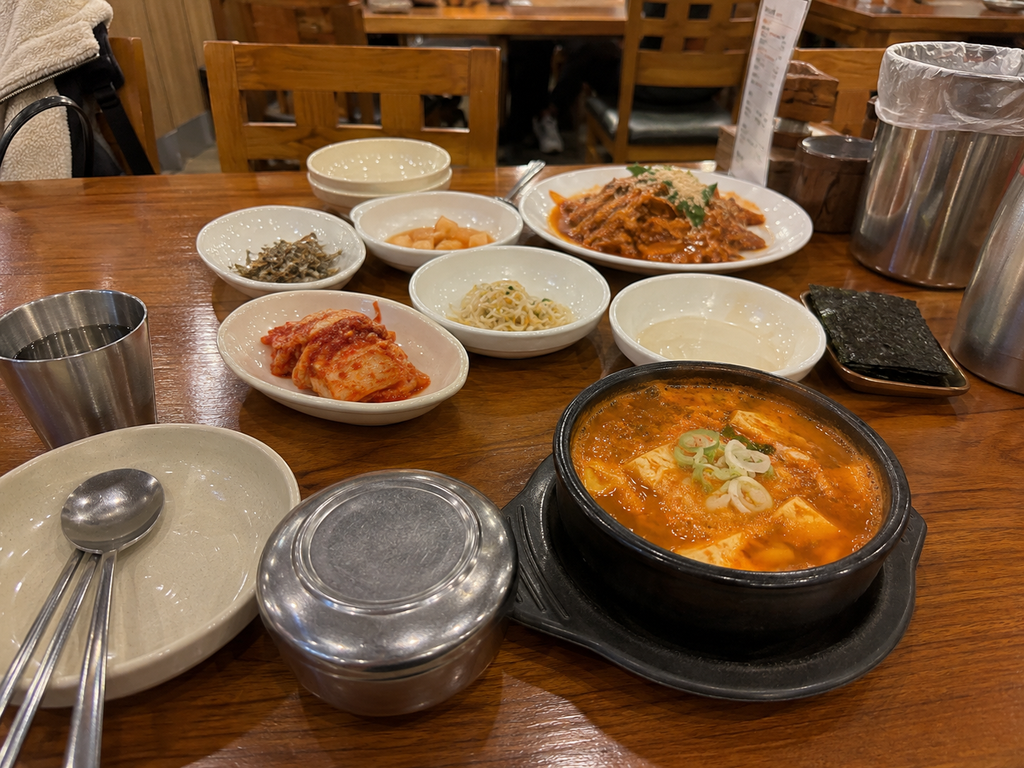
When the server brings your food, a simple:
감사합니다.
Gamsahamnida.
Gam-sa-ham-ni-da.
Thank you.
is enough.
If you need something else during the meal, use the call button or say 저기요 again.
Then you can make a simple request:
물 좀 주세요.
Mul jom juseyo.
Mul jom ju-se-yo.
Some water, please.
Or:
앞접시 하나 주세요.
Apjeopsi hana juseyo.
Ap-jeop-si ha-na ju-se-yo.
One small plate, please.
You don’t need complicated grammar. Knowing 주세요 (juseyo) already lets you make many basic requests.
How to Pay at a Korean Restaurant
When you’re finished eating, the payment process can vary by restaurant.
At many restaurants, you go to the counter to pay. Other places may allow you to pay at the table or through the tablet you used to order.
If you need to tell the staff that you’re ready to pay, say:
계산할게요.
Gyesanhalgeyo.
Gye-san-hal-ge-yo.
I’d like to pay.
After paying, you can simply say:
감사합니다.
Gamsahamnida.
Gam-sa-ham-ni-da.
Thank you.
That’s enough.
A Realistic Restaurant Conversation in Korea
Here’s what a simple restaurant visit might sound like.
Staff: 어서 오세요. 몇 분이세요?
Welcome. How many people?
You: 두 명이요.
Two people.
Staff: 편한 데 앉으세요.
Please sit wherever you’d like.
After looking at the menu:
You: 저기요. 주문할게요.
Excuse me. We’d like to order.
Staff: 네.
Sure.
You: 김치찌개 하나랑 불고기 2인분 주세요. 이거 많이 매워요?
One kimchi stew and two servings of bulgogi, please. Is this very spicy?
Staff: 조금 매워요.
It’s a little spicy.
You: 그럼 덜 맵게 해주세요.
Then please make it less spicy.
Staff: 네.
Okay.
When the food arrives:
Staff: 주문하신 음식 나왔습니다.
Here’s your order.
You: 감사합니다.
Thank you.
After the meal:
You: 계산할게요.
I’d like to pay.
Staff: 네. 감사합니다.
Sure. Thank you.
You: 감사합니다.
Thank you.
You don’t need to memorize this entire conversation. Even if you only remember a few of these phrases, you’ll be able to handle many everyday restaurant situations in Korea.
Real Korean to Remember
If you only remember three expressions from this article, make them these.
저기요.
Jeogiyo.
Jeo-gi-yo.
Use this when you need to get a restaurant employee’s attention.
Natural meaning:
“Excuse me.”
주세요.
Juseyo.
Ju-se-yo.
Add this after the food or item you want.
Natural meaning:
“Please give me…” / “I’d like…”
Once you know this expression, you can use it for food, drinks, water, extra plates, and many other simple requests.
계산할게요.
Gyesanhalgeyo.
Gye-san-hal-ge-yo.
Use this when you’re finished eating and ready to pay.
Natural meaning:
“I’d like to pay.”
With 저기요, 주세요, and 계산할게요, plus a simple 감사합니다, you can get through most of a basic restaurant visit without needing a long conversation.
Want to practice real Korean with me? 🇰🇷
Learn natural Korean conversation with K-Unnie — the kind Koreans actually use in everyday life.
Book a Korean lesson with me →