
Can you sleep in a Korean sauna? If you’re planning a trip to Korea and looking into jjimjilbangs, this is probably one of the first questions you’ll have.
At some jjimjilbangs, yes. But not at all of them.
Some jjimjilbangs that operate 24 hours or allow late-night stays let guests sleep in shared resting areas. Others close at night or have limits on how long you can stay. Just because a place calls itself a jjimjilbang or spa doesn’t necessarily mean you can spend the night there.
For example, as of August 2026, Spa Land Centum City in Busan operates from 8:00 a.m. to 11:00 p.m. and has a limited standard admission time, so it isn’t a place where you can stay overnight.
If you want to sleep at a jjimjilbang in Korea, the first things to check are whether it operates 24 hours and whether overnight stays are actually allowed.
Operating hours, admission fees, and overnight policies vary by facility and can change. Time-sensitive information in this article was checked in August 2026.
My First Jjimjilbang Experience
I first went to a jjimjilbang before I was eight years old.
My mother took me to a public bathhouse that also had a jjimjilbang. Instead of quietly relaxing, I remember wandering around the hot sauna rooms, cooler resting areas, and large shared spaces.
At that age, it felt more like exploring a new place than going to a sauna.
I still enjoy jjimjilbangs today, and when the timing works out, I sometimes use them while traveling.
A Jjimjilbang Is a Little Different From the Bath Area
If it’s your first time, it helps to understand the difference between the bathing area and the shared jjimjilbang area.
The bathing areas are generally separated by gender, and you use them without clothes. You wash yourself before getting into the baths.
After bathing, you change into the provided jjimjilbang clothes and enter the shared area, where men and women can relax together.
Depending on the facility, there may be different heated sauna rooms, resting areas, restaurants or snack bars, and massage chairs.
At jjimjilbangs that allow overnight stays, this shared area is also usually where you’ll see people sleeping.
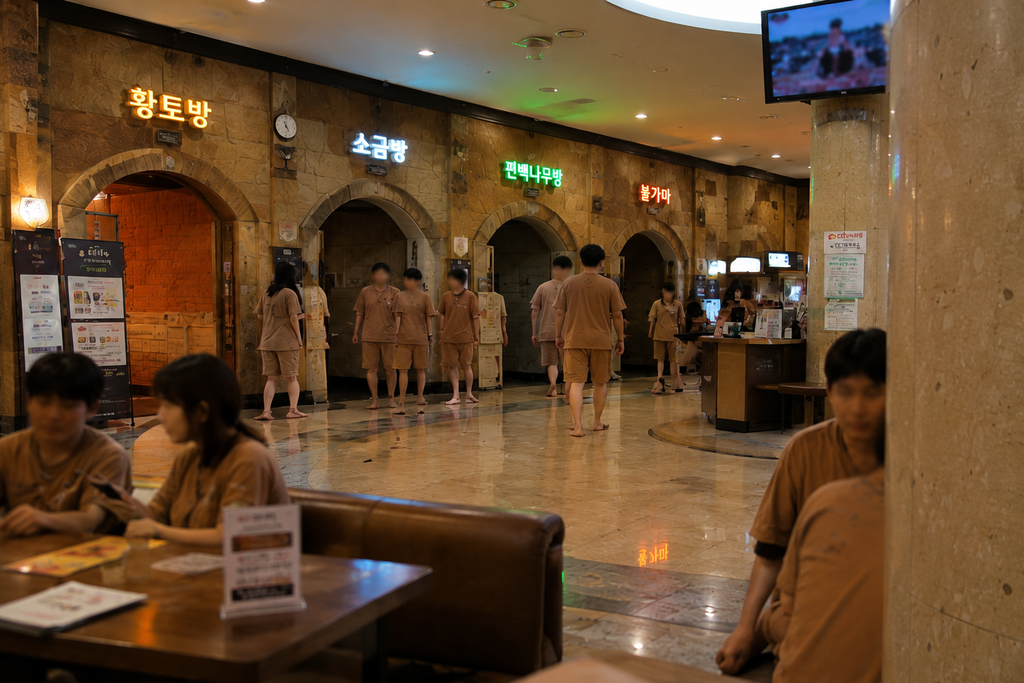
What Is Sleeping in a Jjimjilbang Actually Like?
This is where a jjimjilbang is very different from a hotel.
Sleeping at a jjimjilbang usually does not mean getting a private room.
Instead, you generally sleep in a shared resting area with other guests. Some facilities may have designated sleeping rooms or separate resting spaces, but the setup varies from place to place.
If you need a private, quiet room and a proper bed to sleep comfortably, it’s better not to think of a jjimjilbang as a replacement for a hotel.
But if you’re comfortable sleeping in a shared space and mainly need somewhere to shower, rest, and sleep for a few hours, an overnight jjimjilbang can be an option.
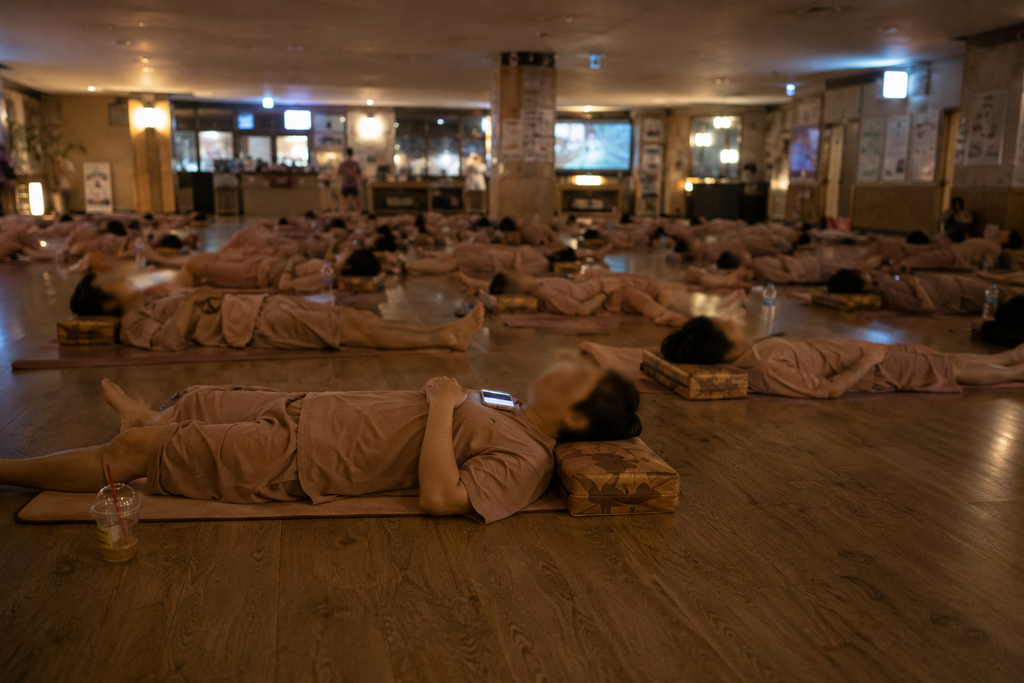
Don’t Choose One Based on Price Alone
You may see older travel guides quoting a typical price range for overnight jjimjilbang stays, but prices and late-night fees vary by facility and can change.
Some places have different daytime and nighttime rates, while others may charge an additional fee for staying late.
If you’re considering a jjimjilbang to save on accommodation, check these three things before you go:
Is it open 24 hours? Are overnight stays allowed? What will the total nighttime fee be?
If you can’t confirm those things, don’t assume you’ll be able to spend the night simply because the facility is called a jjimjilbang.
What First-Time Visitors Often Find Unfamiliar
One of the biggest adjustments for a first visit can be the bathing area.
The bath area is separated by gender, and swimsuits generally aren’t worn. You wash yourself before entering the baths.
After bathing, you put on the provided jjimjilbang clothes and move into the shared sauna and relaxation areas.
If you’re there late at night, people may already be sleeping. Keep your voice down and avoid playing audio from your phone loudly around sleeping areas.
What I Bring to a Jjimjilbang
Some jjimjilbangs sell basic toiletries, but what is provided or available for purchase varies by facility.
I usually bring my own travel-sized toiletries from Daiso along with my skincare products.
One thing I personally like to bring is a sheet mask.
After spending time in the heated rooms, I like to shower and use a sheet mask while I’m relaxing.
I also bring extra underwear. I prefer changing into clean underwear after showering before putting on my jjimjilbang clothes, and then changing into another fresh pair before I leave.
That isn’t a jjimjilbang rule. It’s simply a habit I’ve developed after going many times.
Keep Your Valuables in Your Locker
I’ve been to jjimjilbangs more than 100 times and have never personally lost anything.
That doesn’t mean I recommend leaving valuables next to you while you sleep.
You’ll generally have a locker, so keep important belongings such as your wallet, cash, and passport locked away. When you’re traveling, especially, it makes sense to be careful with anything that would be difficult to replace.
What I Like to Eat at a Jjimjilbang
I still use jjimjilbangs while traveling when it makes sense for my schedule.
If all I need is somewhere to wash, rest, and sleep for a few hours, I find them convenient.
And there are a few things I particularly like having at a jjimjilbang: cold sikhye, maekbanseok eggs, and miyeokguk, or seaweed soup, with rice.
For me, eating these foods after spending time in the sauna is part of what I enjoy about going to a jjimjilbang.

In summer, I sometimes look for facilities that also have water parks. When the weather is cooler, I enjoy more traditional hanjeungmak, or Korean kiln-style saunas.
But having a water park or a premium spa doesn’t mean a facility allows overnight stays, so I still check the operating hours separately.
Is Sleeping in a Jjimjilbang Worth Trying?
If you’re comfortable sleeping in a shared space and the jjimjilbang you choose actually allows overnight stays, it can be worth trying.
For me, it can be a convenient option when I mainly want somewhere to bathe, relax, and sleep for a few hours.
But a jjimjilbang is not a hotel.
You aren’t guaranteed a private room, a bed, or a quiet sleeping environment, and not every jjimjilbang stays open 24 hours.
So instead of thinking, “I can sleep at any jjimjilbang in Korea,” the more accurate way to think about it is:
“I need to find a jjimjilbang that specifically allows overnight stays.”
Today’s Korean
여기서 자도 돼요?
Romanization: Yeogiseo jado dwaeyo?
Say it like: Yeo-gi-seo ja-do dwae-yo?
Natural meaning: “Can I sleep here?”
You can use this when you’re not sure whether sleeping is allowed in a particular resting area.
몇 시까지 해요?
Romanization: Myeot sikkaji haeyo?
Say it like: Myeot-si-kka-ji hae-yo?
Natural meaning: “What time do you close?”
This is a useful way to ask about closing time when you’re not sure whether a jjimjilbang is open 24 hours.
Want to practice real Korean with me? 🇰🇷
Learn natural Korean conversation with K-Unnie — the kind Koreans actually use in everyday life.
Book a Korean lesson with me →