
If you’re traveling around Korea, a transportation card is one of those things you’ll probably need sooner than you expect.
You might take the subway from your hotel to a tourist attraction, hop on a bus to get somewhere nearby, or switch between the two several times in one day.
For people living in Korea, this is just part of everyday life.
We take buses and subways to school, to work, to meet friends, and pretty much everywhere else. This is especially true in Seoul, where driving can mean dealing with heavy traffic and finding a place to park.
Unless I’m going somewhere like a supermarket and need to carry a lot of groceries home, I usually find public transportation much easier.
I also grew up taking buses and subways, so tapping a transportation card at a subway gate or when getting on a bus feels completely automatic to me.
But when you’re visiting Korea for the first time, the little details aren’t so obvious.
Where do you buy a transportation card?
Do you need cash to top it up?
And are you supposed to tap your card again when you get off a bus?
This guide will keep things simple. Instead of comparing every transportation card available in Korea, I’ll show you how to buy a Tmoney card, add money to it, and actually use it on Korean subways and buses.
Card prices and purchase/top-up information in this guide were checked against official Korea tourism information updated in August 2026.
Why a Transportation Card Is Useful in Korea
If you’re going to use buses and subways several times during your trip, having a transportation card is much more convenient than dealing with a separate ticket every time you travel.
Tmoney and EZL are prepaid transportation cards. You add money to the card first and then tap it when using public transportation.
They can also make transfers between eligible buses and subways more convenient, with transfer discounts applying under the relevant fare rules.
For someone who has lived in Korea for years, the whole process feels incredibly ordinary.
Tap your card.
Take the bus.
Transfer to the subway.
Tap again when you leave.
You barely think about it.
Tmoney isn’t limited to public transportation, either. You can also use the balance on your card like prepaid money at convenience stores and other participating Tmoney merchants.
So once you know how it works, it can be a handy little card to have throughout your trip.
Where to Buy a Tmoney Card in Korea
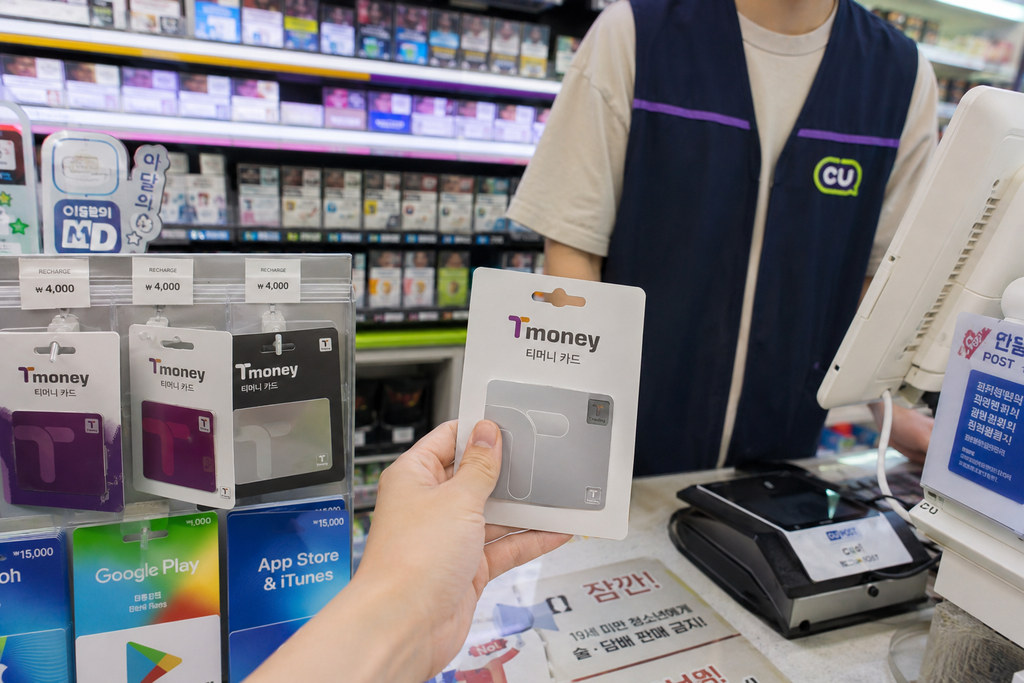
The easiest place for most travelers to buy a Tmoney card is a convenience store.
You can find Tmoney cards at major convenience store chains around Korea, including GS25, CU, and 7-ELEVEN.
In Seoul, they are also available at information centers in subway stations on Lines 1–8.
A standard Tmoney card generally costs around 3,000–5,000 won.
One important thing to remember:
The price of the card itself is separate from the money you’ll use for transportation.
Buying the card doesn’t mean it already has enough balance for your subway or bus rides. You’ll need to add money to it before using it.
At a convenience store, you don’t need to explain much.
Try saying:
티머니 카드 있어요?
T-money kadeu isseoyo?
“Do you have a Tmoney card?”
Or simply:
교통카드 하나 주세요.
Gyotong kadeu hana juseyo.
“One transportation card, please.”
How to Top Up a Tmoney Card
Once you have your Tmoney card, the next step is adding money to it.
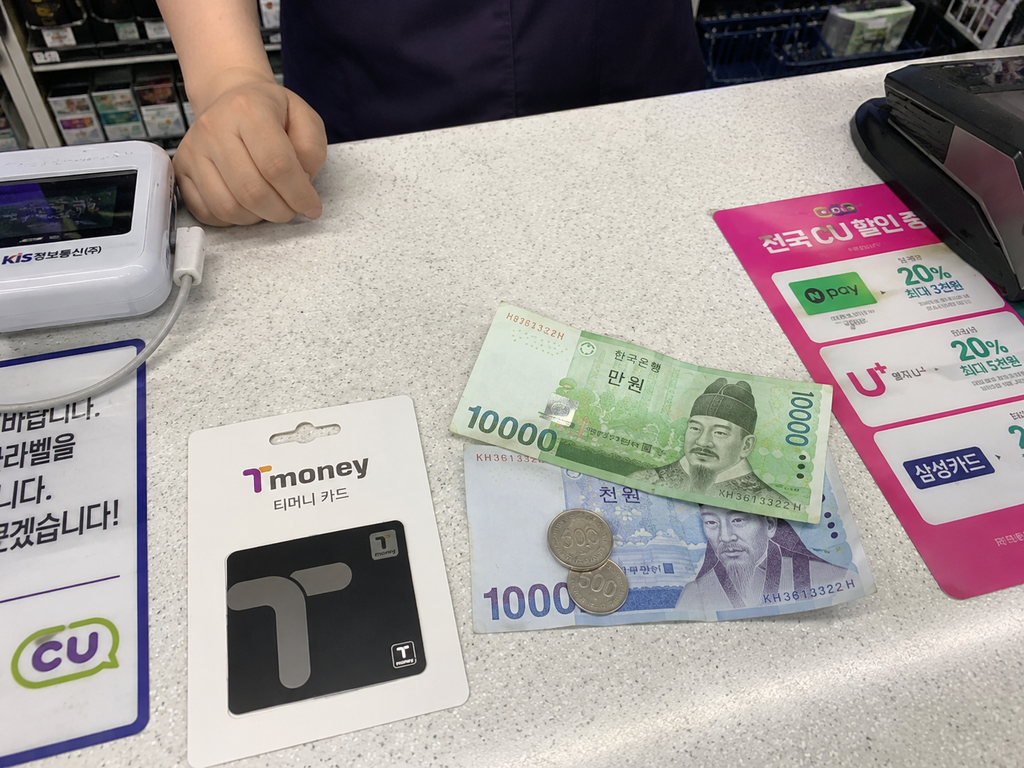
You can usually top it up at a convenience store or use a compatible ticket vending/top-up machine inside a subway station.
There is one detail international travelers should know before trying to pay.
According to the Korea Tourism Organization’s 2026 transportation guide for international visitors, foreign-issued credit cards cannot be used to purchase or top up a regular prepaid Tmoney card. You’ll need cash.
This can be surprisingly easy to overlook because card payments are extremely common in Korea.
So if you’re heading to a convenience store to buy and load a Tmoney card, keep some Korean won in cash with you.
If you want to add 10,000 won, hand the card to the cashier and say:
만원 충전해 주세요.
Man won chungjeonhae juseyo.
“Please add 10,000 won.”
That’s enough. You don’t need a complicated conversation.
How to Use Tmoney on the Subway
Using Tmoney on the subway is straightforward.
When you enter the subway station, find the gate and tap your Tmoney card on the card reader.
After reaching your destination, you’ll tap it again at the exit gate.
Think of it like this:
Tap in → Take the subway → Arrive → Tap out
If you don’t have enough balance, don’t panic.
Look for a top-up machine or assistance inside the station, add money to your card, and then continue.
Once you’ve done this a couple of times, using the subway in Korea becomes very easy.
How to Use Tmoney on a Bus
Buses work in a similar way, but there is one step that first-time visitors can easily miss.
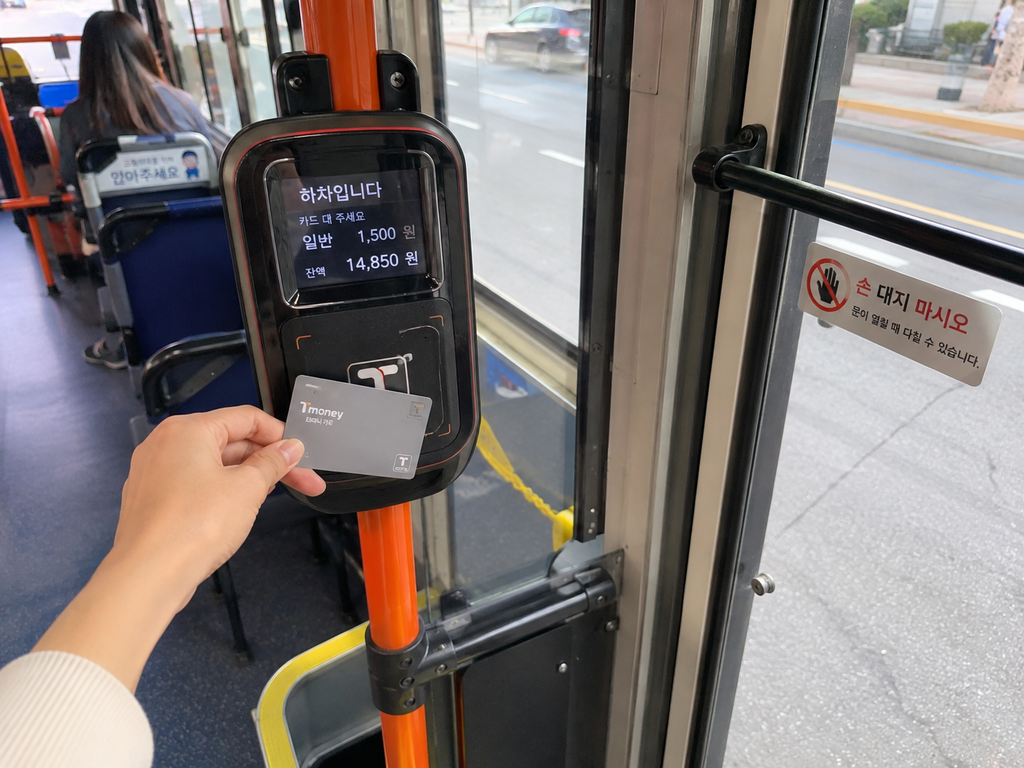
When you get on the bus, tap your Tmoney card on the card reader near the entrance.
Then, tap it again when you get off.
This is a normal habit for people living in Korea, so you’ll probably notice other passengers tapping their cards as they approach the exit.
Tapping when you get off is especially important when transfer discounts or distance-based fares apply.
For a first trip, the easiest rule to remember is:
Bus = Tap when you get on + Tap when you get off.
If you’re transferring from the bus to another bus or the subway, remembering that second tap becomes even more important.
How Much Money Should You Put on Your Tmoney Card?
This is another common question, but there isn’t one perfect amount for every traveler.
How much transportation costs during your trip will depend on where you’re staying, how many times you travel each day, where you’re going, and whether you’re traveling outside Seoul.
So I wouldn’t recommend loading a large amount just because someone says that’s what you’ll need for a three-day or five-day trip.
Start with an amount that makes sense for your immediate plans.
If your balance gets low, you can simply add more at a convenience store or a subway top-up machine.
There’s no need to estimate your entire trip’s transportation spending on your first day.
Are There Other Transportation Cards in Korea?
Yes.
Tmoney isn’t the only option available.
You may also come across EZL, and travelers may consider cards and passes such as WOWPASS or Seoul’s Climate Card, depending on how they plan to travel.
But they aren’t exactly the same product, and comparing all of them properly deserves a separate guide.
Climate Card options are also changing from October 1, 2026, so travelers visiting around or after that date should check the latest official information before deciding which pass to buy.
For now, if your goal is simply to understand how a regular Korean transportation card works, remember this:
Buy a Tmoney card → Top it up with cash → Tap in and out on the subway → Tap when getting on and off the bus
Once you’ve done it for the first time, it will probably feel much simpler than it did when you were planning your trip.
Today’s Korean: 3 Useful Phrases
1. 티머니 카드 있어요?
Romanization: T-money kadeu isseoyo?
Easy pronunciation: T-money ka-deu i-sseo-yo?
Meaning: Do you have a Tmoney card?
Use this at a convenience store when you want to ask whether they sell Tmoney cards.
2. 교통카드 하나 주세요.
Romanization: Gyotong kadeu hana juseyo.
Easy pronunciation: Gyo-tong ka-deu ha-na ju-se-yo.
Meaning: One transportation card, please.
This is useful when you simply want to ask for a transportation card without specifying a particular design.
3. 만원 충전해 주세요.
Romanization: Man won chungjeonhae juseyo.
Easy pronunciation: Man-won chung-jeon-hae ju-se-yo.
Meaning: Please add 10,000 won.
Hand your Tmoney card to the cashier and use this phrase when you want to add 10,000 won to the balance.